


A tool to encourage people to speak
In pathways to employment, communication is often a major challenge. Many young people or adults receiving support find it difficult to talk about themselves, identify their skills or envisage a professional future. These obstacles are even more pronounced for people with low literacy levels, limited proficiency in French or a difficult educational background.
For Florence Gouin, a professional in the field of integration who has worked at Trajet Association and then at GRETA in Redon, photolanguage offers a particularly interesting solution to these challenges.
Developed in the 1960s by Claire Bélisle and Daniel Rodary, the photolanguage method relies on the use of photographs as a medium for expression and exchange. The aim is to facilitate communication, encourage personal expression and enable everyone to take part in discussions, regardless of their reading or writing skills. Florence emphasises that “Photolanguage makes communication more accessible because it engages both the cognitive and emotional aspects of each individual, drawing on their life experiences.”
From plain language to authentic expression
Photolanguage does not replace plain language. It complements it.
Whilst plain language aims to convey information that is understandable and accessible, photo-language acts more as a catalyst for speech. The image does not merely serve to illustrate a message: it becomes a medium enabling everyone to express their emotions, aspirations or experiences.
According to Florence Gouin, the two approaches are particularly complementary. Together, they create spaces that encourage listening, participation and learning.
Photographs also help to overcome certain barriers related to reading or language proficiency. They draw on memories, emotions and personal experiences even before words are needed.
An experiment with young people in integration programmes
Florence Gouin has developed an original experiment with young people aged 16 to 25 supported through the Prépa Avenir Jeunes scheme run by GRETA in Redon.
The initial observation was simple: traditional methods of job-seeking and self-presentation can be unsettling for some young people. CVs, cover letters and job interviews rely heavily on verbal skills that not everyone has mastered.
The aim was therefore to help participants identify their skills and learn to talk about themselves in a different way.
The project was structured around several stages:
- taking photographs during the work placement periods;
- identifying and articulating the skills used;
- linking these to France Travail’s occupational reference frameworks;
- creating a table entitled ‘CV vs Photos’;
- an oral presentation of the work carried out to the group.
The support programme systematically combined group sessions with individual interviews.
For Florence Gouin, this dual approach is essential:
“Group work encourages discussion, speaking in front of others and the development of self-confidence. Individual support, on the other hand, helps to build a relationship of trust and allows for deeper personal reflection.”
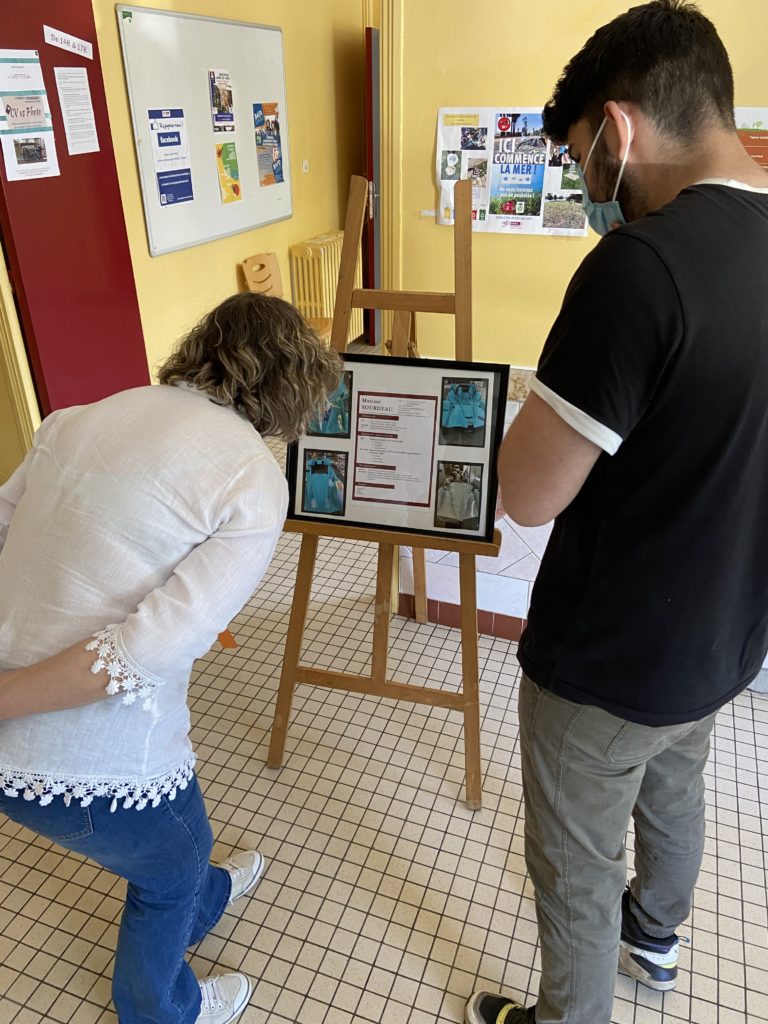
Visible effects on participation and self-confidence
The reactions observed among the young people were particularly encouraging.
The presence of photographs in a training space initially elicits surprise, then curiosity, and finally engagement. Gradually, the more reserved participants begin to speak up more.
The project does not merely draw on communication skills. Creating the ‘CV vs Photos’ board also requires creativity, spatial awareness, concentration and collaborative work.
Young people take control of their own journey.
Photolanguage also helps raise awareness of the skills developed during work placements or in daily life. Participants learn to put their skills into words and to highlight their experiences to professionals or employers.
As Claire Bélisle observed, the discussions sparked by the photographs often lead to a genuine realisation of oneself and one’s abilities. “It became apparent that the discussion sparked by the photographs (…), led to a realisation and triggered a reaction to what was discovered.”
Conditions for success and points to bear in mind
However, the implementation of photolanguage requires certain precautions.
The framework must be clearly defined from the start of the activity to ensure mutual respect, active listening and kindness.
The facilitator plays a central role. Their approach must be based on listening, being available and non-judgemental.
Among the difficulties encountered during the trial, Florence Gouin highlights in particular:
- maintaining contact with the young people during their work placements;
- remote monitoring;
- collecting photographs within the agreed deadlines;
- the need to involve the host organisations in the process.
She also stresses the importance of never leaving a participant to face difficulties alone during their journey.
“Being there without putting pressure on them, remaining available and listening are essential for success.”
What photolanguage teaches us about inclusive communication
The experiment conducted with young people in employment support programmes highlights a fundamental principle of inclusive communication: everyone possesses resources, knowledge and experience that deserve to be recognised.
The role of the professional is not to impart a single set of knowledge but to create the conditions that allow everyone to express their potential.
From this perspective, photo-language appears to be a particularly relevant tool for professionals working in youth, integration and education. By relying on images, it helps to reduce certain barriers associated with the written word, to value individual experiences and to boost self-confidence.
At a time when smartphones are making photography accessible to a wider audience, this approach offers promising prospects for developing support practices that are more inclusive, more participatory and more person-centred.