


Formation
La communication inclusive ne consiste pas seulement à simplifier l’information. Son objectif est que chaque jeune puisse accéder aux informations qui le concernent, les comprendre et les utiliser.
Dans le cadre du projet That’s Clear!, les partenaires ont développé un programme de formation complet pour aider les professionnels de jeunesse, les éducateurs, les organisations de jeunesse et les professionnels de la communication à adopter des pratiques de communication claires et inclusives.
Cette formation s’appuie sur la phase de diagnostic du projet ainsi que sur les expériences recueillies auprès de professionnels de jeunesse et de jeunes dans différents pays européens. Elle propose des méthodes pratiques, des outils prêts à l’emploi, des exemples concrets et des ressources directement utilisables pour rendre la communication plus accessible à tous, en particulier aux jeunes confrontés à des difficultés de lecture et de compréhension, à des barrières linguistiques ou à d’autres obstacles dans leur accès à l’information.
Pour répondre aux différents besoins d’apprentissage, la formation est proposée sous deux formats complémentaires :
• une formation en présentiel, testée lors de l’activité internationale d’apprentissage, d’enseignement et de formation en Espagne (LTTA) ;
• une formation numérique en autonomie, qui permet à chacun de progresser à son propre rythme.
Les deux formats abordent les mêmes modules et les mêmes objectifs d’apprentissage, tout en proposant des expériences de formation différentes.
Les 5 diaporamas + toutes les fiches d’activités (.zip)
⌄
›
The “That’s clear!” project focuses on inclusive and accessible communication in youth work.
Its goal is to break down barriers and give young people better access to information and programs. It specifically targets young people with immigrant backgrounds, learning difficulties, or social disadvantages.
The project combines inclusion, digital tools, and modern educational approaches. It is not only about simplifying language but also about social participation and equal opportunity. Young people are actively involved in the development of materials and help shape the content.
This creates a participatory approach that is practical and needs-oriented.
›
Inclusion means that all people can participate on an equal basis, regardless of their background, abilities, or level of education. This is particularly important in youth work, as many young people with different backgrounds come together. Diversity describes the variety within a group and highlights the need to take different perspectives into account.
The project demonstrates that traditional forms of communication are often not sufficiently inclusive. Access is intended to be facilitated through simple language, visual aids, and participatory methods. Young people should feel taken seriously and be able to actively participate.
Inclusive communication thus becomes a central tool for social justice and democratic participation.
›
Inclusive communication is essential for ensuring that every young person can access information, participate in activities, and feel part of their community. As a youth worker, your role is to communicate in ways that are clear, respectful, understandable and accessible to young people with different backgrounds, languages, literacy levels, and abilities.
Inclusive communication starts with understanding the needs of your target group and using this understanding to adapt how you communicate. This may mean using plain language instead of jargon, structuring information clearly, supporting messages with visuals, or choosing communication methods that encourage participation. It also requires active listening, empathy, and adapting your communication style to different situations and individual needs. By combining verbal, non-verbal, and visual communication, you can make information easier to understand and create a more welcoming environment for everyone.
In this module, you will learn why communication is a key factor for participation, trust, and equal opportunities. You will explore common communication barriers and discover practical strategies to overcome them. These methods will help you develop the confidence and skills to create inclusive learning environments where every young person feels informed, respected, and empowered to participate.
›
Communication is far more than the mere exchange of information. It is a social process through which relationships are formed and meanings are conveyed.
People communicate constantly—consciously or unconsciously—through language, behaviour, and symbols. Communication influences how people perceive and understand one another. Especially in inclusive groups, it is important to consciously shape communication processes. Misunderstandings or unclear messages can quickly lead to exclusion. The project therefore conveys an expanded understanding of communication that takes into account linguistic as well as emotional and social aspects. Good communication builds trust, promotes cooperation, and enables social participation.
Image
Exercise
›
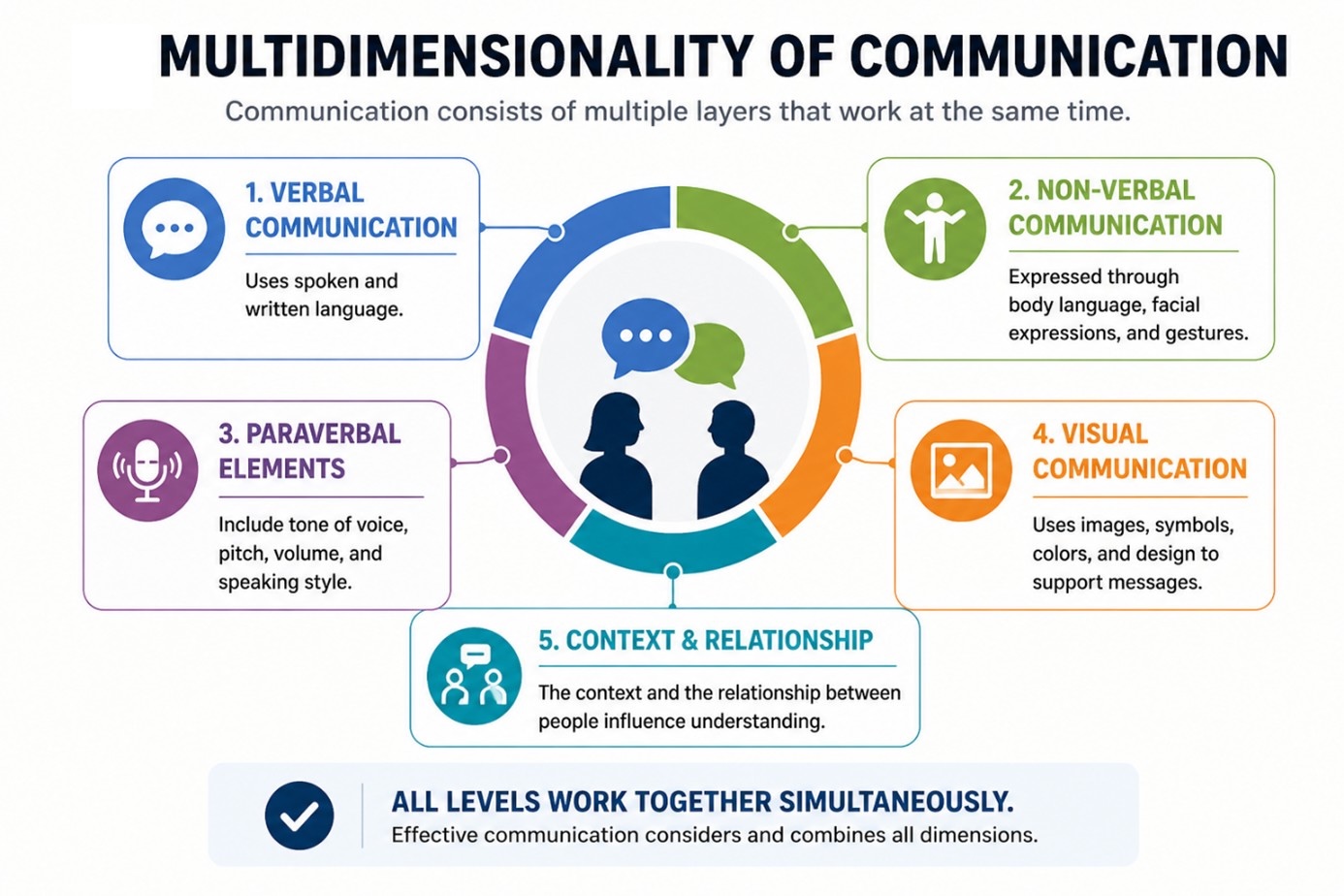
Communication distinguishes between four central forms: verbal, nonverbal, paraverbal, and visual.
Verbal communication encompasses spoken or written language.
Nonverbal communication includes body language, facial expressions, and gestures.
Paraverbal communication describes aspects such as volume, intonation, or speaking pace.
Visual communication works with images, symbols, or colours. These levels usually operate simultaneously and collectively influence how messages are understood.
Especially in inclusive groups, the combination of different forms of communication plays an important role. People with language barriers benefit particularly from visual or nonverbal elements. This makes communication more accessible and understandable.
Which Type of Communication? (10 minutes)
Communication is more than speaking. Every message combines different forms of communication. As a youth worker, using more than one communication type helps young people understand information and feel included.
Video
›
The sender-receiver model by Shannon and Weaver describes communication as a transmission process between two people.
One person sends a message via a specific channel to a recipient. Interference can occur during this process, affecting comprehension.
In the model, feedback plays an important role, as it indicates whether the message was understood. The ‘That’s clear!’ project uses this model to highlight communication issues. Differing perceptions, cultural backgrounds, or unclear phrasing can lead to misunderstandings.
The model helps analyse communication more consciously and better identify barriers. This allows communication processes to be improved in a targeted manner.
›
Communication barriers arise when messages are not properly understood or interpreted. Causes can include linguistic differences, prior knowledge, or emotional factors. Misunderstandings occur frequently, especially in heterogeneous groups. The project shows that noise, a lack of feedback, or differing cultural experiences can also complicate communication processes. People often interpret information differently, depending on their experiences and expectations. Therefore, it is not enough to simply provide information—it must also be conveyed in a way that is understandable.
Inclusive communication aims to reduce these barriers and create greater clarity. This improves collaboration and promotes participation.
›
Reflection supports self-directed learning because it allows participants to recognize their strengths and challenges. At the same time, new perspectives on communication and inclusion emerge. The project demonstrates that learning is particularly sustainable when theory, experience, and personal reflection are combined. As a result, participants develop more conscious and empathetic communication behaviours.
Image
›
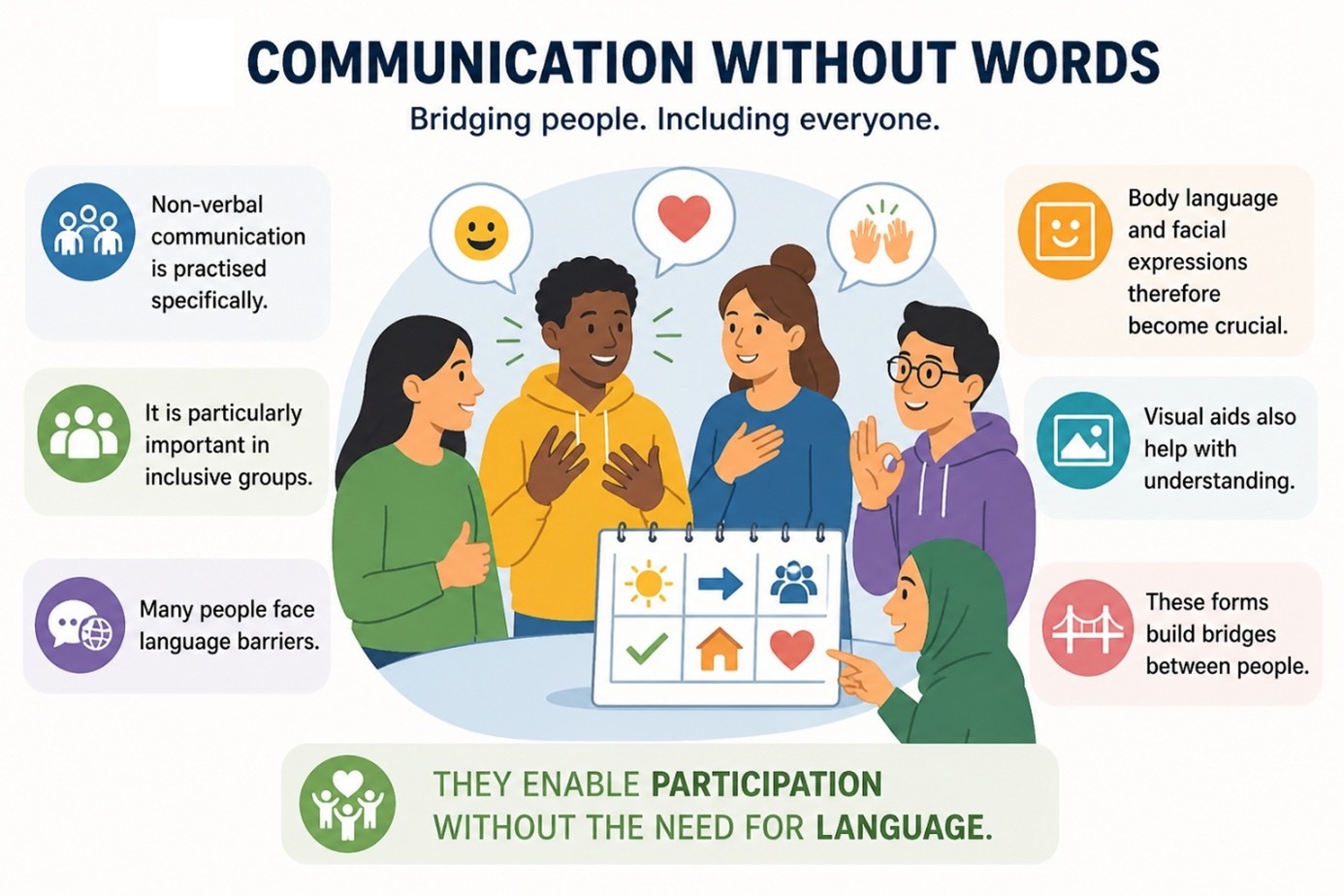
Nonverbal communication plays a particularly important role in inclusive groups. Many people face language barriers, for example due to migration, learning difficulties, or insecurity. Body language, facial expressions, and gestures can therefore serve as important bridges between people.
The ‘That’s clear!’ project demonstrates that nonverbal signals are often understood more quickly than complex language. At the same time, they convey emotions and relationships. Exercises such as pantomime or acting out emotions foster awareness of this form of communication. Participants learn to pay closer attention to nonverbal signals and to better assess their own impact. This fosters greater understanding, empathy, and mutual support within the group.
›
Communication plays a key role in creating inclusive and welcoming environments for young people. By using plain language, visual support, and clear communication, you can make information easier to understand and ensure that every young person has the opportunity to participate. You will learn how to recognise communication barriers, adapt your communication to different needs, and build trust with young people from diverse backgrounds.
Creative methods such as drawing, role-playing, storytelling, and pantomime demonstrate that communication is much more than spoken words. These activities, which you will experience during the face-to-face training, provide practical strategies for encouraging participation, strengthening teamwork, and supporting young people with different communication needs. They also show how non-verbal communication can help overcome language and literacy barriers.
The aim is to help you transfer these approaches into your daily youth work, creating activities that are more accessible, engaging, and inclusive. By applying these principles, you can empower young people to express themselves, actively participate, and feel valued within their communities.
Key takeaways
- Communication is a two-way process — it is not just about sending a message
- Good communication benefits all audiences, not just those with literacy challenges
- Knowing your audience is the first step to communicating effectively
›
⌄
›
Daily life is very challenging on many levels – fighting with time, struggling with multiple issues and emergencies. But behind all that, there is something that is easy to overlook. But it has a great impact on our lives – language and communication barriers.
Some of them are linked to disabilities or neurodevelopmental conditions. Some might be caused by social, educational, emotional, or environmental factors.
No matter the reason, we must be aware that difficulties with reading and writing can affect access to information, education, social participation, and youth services.
For some young people, understanding written information requires much more effort than for others, especially when texts are long, complex, or filled with unfamiliar vocabulary.
Communication barriers may also appear when young people are not fluent in the local language, experience stress or fatigue, or encounter inaccessible digital content.
These barriers can directly impact young people’s self-perception. They may lead to reduced confidence, increased frustration, and discouraged participation. Young people might also feel excluded and have lowered self-esteem.

›
›
Communication barriers can affect a wide range of people, not only individuals with diagnosed learning disabilities. They may also occur at different stages of life. Imagine a person who, as an adult, had an accident and lost hearing, or got sick, which resulted in vision loss. Suddenly, they found themselves excluded from access to information. This is why plain language is so important. It makes communication accessible to a wide range of users, regardless of whether their limitations are innate or acquired.
Plain language makes communication much more inclusive to those with sensory, cognitive, psychological, motor, or situational barriers. Young people experiencing stress, fatigue, anxiety, illness, low literacy, or language difficulties may also struggle to understand information. Some barriers are visible, while others remain invisible to others. Communication barriers may affect reading comprehension, concentration, memory, navigation of digital tools, or confidence when interacting with services.
In youth facilities, inaccessible communication can unintentionally exclude participants from activities, opportunities, or support systems. By recognising the diversity of communication needs, youth workers can create more inclusive environments. Adapting language, simplifying information, and using multiple communication formats help ensure that more young people can access and understand important information.

›
Cognitive and neurodevelopmental barriers affect how people process, organise, and understand information. These barriers may be linked to conditions such as dyslexia, ADHD, autism spectrum disorder, dysgraphia, or language processing difficulties.
Young people experiencing these barriers may find it difficult to identify key information, maintain attention, process long texts, or understand complex instructions. Reading and writing tasks may require more time and mental effort, which can lead to cognitive overload and fatigue. Communication that is unclear, visually dense, or poorly structured can increase frustration and reduce engagement.
However, accessible communication strategies can significantly reduce these difficulties. Using plain language, short sentences, clear layouts, visual supports, and predictable structures helps young people process information more efficiently. Inclusive communication does not eliminate challenges entirely, but it creates fairer and more supportive conditions for learning and participation.

›
›
Psychological barriers can influence how young people process, understand, and engage with information. Conditions such as anxiety disorders, depression, trauma-related difficulties, bipolar disorder, or social anxiety may affect concentration, motivation, confidence, and emotional regulation.
Young people experiencing psychological barriers may feel overwhelmed by long or complex information, avoid official communication, or struggle to ask questions when they do not understand something. Stress and anxiety can reduce working memory capacity, making it more difficult to process written or spoken content effectively.
Supportive communication can help reduce these barriers. Using reassuring language, predictable structures, clear explanations, and non-judgmental communication creates safer and more inclusive environments. We can’t forget that communication difficulties are not always linked to ability, lack of motivation or “laziness” – emotional well-being can strongly influence how accessible information feels to an individual.

›
These communication difficulties may be temporary or not immediately visible. They can include fatigue, stress, illness, low literacy, temporary cognitive overload, limited digital skills, or communicating in a non-native language. And they may happen to any of us.
Ask yourself a question: To what degree can you focus with a headache?
When experiencing these kinds of barriers, a young person may usually understand information well but struggle in specific situations due to exhaustion, emotional stress, or environmental demands. Situational barriers are important because they show that accessibility concerns everyone, not only people with diagnosed disabilities. Communication that is overly complex, rushed, or poorly structured can create exclusion even for individuals without long-term difficulties. This is another argument for why youth organisations should work to reduce situational barriers. They can do that by using clear language, offering information in multiple formats, allowing extra processing time, and avoiding unnecessary jargon.
›
Communication barriers rarely exist in isolation. Many young people experience overlapping barriers that interact and increase communication difficulties. For example, a young person with hearing loss may also experience anxiety in group discussions, while someone with ADHD may struggle even more in noisy or stressful environments. Low literacy combined with fatigue, stress, or non-native language use can significantly reduce access to information and services.
Overlapping barriers demonstrate why inclusive communication should consider multiple needs simultaneously. A strategy that supports one person may also benefit many others. Using plain language, visual organisation, flexible communication methods, and supportive environments can reduce the cumulative effect of barriers. Understanding overlap also helps youth professionals avoid assumptions.

›
Literacy skills involve much more than simply reading and writing.
According to the OECD PIAAC framework, literacy is the ability to understand, evaluate, use, and engage with written texts in order to participate effectively in society. Literacy skills help people access education, employment, healthcare, digital services, and social participation.
Different international tools measure literacy levels, including PIAAC and UNESCO’s LAMP programme. These assessments evaluate how people process information, interpret texts, compare sources, and solve real-life communication tasks. Literacy levels range from basic understanding of short familiar texts to advanced analysis of complex information. Measuring literacy helps governments and organisations identify communication barriers and improve accessibility policies. It also highlights the importance of clear and inclusive communication.

›
Literacy skills strongly influence many aspects of daily life, including education, employment, health, civic participation, and access to services.
People with stronger literacy skills are generally more likely to find employment, report good health, understand public information, and participate actively in society. They may also feel more confident navigating administrative procedures, digital tools, and official communication.
Lower literacy levels, however, can increase the risk of social exclusion, misunderstanding of important information, and avoidance of support services. Difficulties understanding forms, contracts, health instructions, or online platforms may limit independence and participation. Literacy also affects self-confidence and social engagement.
Providing clear, well-structured and understandable information is not only an educational issue but also a social inclusion and participation issue.

›
⌄
Video
›
Plain language is not only about using “easy words”. It is about helping people understand information, feel confident, and participate fully in society. When communication is too complex, people may feel excluded, stressed, or reluctant to ask questions. This can affect anyone, but it can create even greater barriers for young people facing language barriers, low literacy, learning difficulties, or unfamiliar systems.
During a workshop on inclusive communication, participants explored this issue through real-life examples, including confusing airport transport systems, difficult online forms, and administrative documents full of jargon. These examples showed that even skilled readers can struggle when information is unclear or poorly structured. Unclear communication creates barriers for everyone.
Plain language improves understanding, reduces mistakes, and helps people act independently. It supports autonomy, dignity, and equal access to information.
This video is a good example about how to produce clear videos about complex subjects.
›
Plain language focuses on words and sentences, while universal design considers the whole communication experience: structure, layout, visuals, formats, readability, and navigation. The two approaches complement each other. A text may use simple vocabulary but still be difficult to understand if the information is badly organised or visually confusing.
A workshop on inclusive communication explored this idea through practical examples, including badly organised recipes, unclear train systems, and websites where essential information is difficult to find. These examples showed that making information accessible is not only about the words we use. It also depends on visual hierarchy, spacing, contrast, icons, audio support, and intuitive organisation.
Universal design means considering these different aspects from the start and designing information for as many people as possible, without creating separate versions for different groups. The goal is to reduce barriers and make communication more inclusive for everyone.
›
One important concept in inclusive communication is cognitive load. When a text is too dense, technical, or badly structured, the brain must do too many things at once: decode unfamiliar words, follow long sentences, identify key information, and remember references to other sections.
Legal and administrative texts are common examples. A document may contain a single very long sentence, unfamiliar terminology, and multiple references to laws, regulations, or annexes. Even when the information itself is relevant and accurate, the way it is presented can make it difficult to understand and process.
When cognitive load becomes too high, understanding decreases — even for highly educated readers. Communication problems are not necessarily caused by people’s abilities, but can result from the way information is designed. Plain language reduces cognitive effort by simplifying structure, shortening sentences, and improving visual organisation.
Cognitive Load: What Have You Learned? (5 minutes)
›
Communication is not only about sharing information. It is also about creating trust between organisations and the people they communicate with.
When people do not clearly understand how their personal data is used, how to access a service, or what their rights are, they may feel insecure, confused, or suspicious. This often happens with legal notices, administrative procedures, consent forms, or terms and conditions written in very technical language. Some texts can feel “designed not to be understood”, especially when they contain long sentences, legal jargon, or constant references to laws and annexes.
However, clear communication does not mean removing all technical or legal information. Some concepts need precise wording because they have important legal consequences. For example, expressions such as “explicit consent” may seem complex, but they carry a specific legal meaning that should not disappear during simplification.
The challenge is therefore to balance accessibility and accuracy. A good plain language approach keeps the essential meaning while making the information easier to understand. One useful solution is to provide two levels of information:
- a short and accessible plain language explanation;
- and access to the complete official or legal version for readers who want more details.
Clear communication helps people feel informed, respected, and confident. It improves transparency and strengthens the relationship between institutions, organisations, and citizens.
›
The goal of communication is not only to share information. Good communication should also help people understand what they need to do and give them the confidence to act independently.
This approach is sometimes called the “literacy lens”. It means looking at communication from the reader’s point of view and asking a simple question: “What should this person be able to do after reading this information?”
In everyday life, people often need information in order to act. They may need to:
- fill in a form;
- register for a service;
- vote;
- attend an activity;
- understand healthcare instructions;
- access cultural resources;
- or make an informed decision.
When communication is unclear, people may hesitate, make mistakes, abandon the process, or lose access to important rights and services.
Plain language helps avoid these situations by making actions clear and visible. One important technique is the use of action verbs such as: “register”, “contact”, “confirm”, “choose”, “vote”, or “complete”.
Clear communication also means identifying the most important information and separating it from secondary details. Readers should quickly understand:
- what the message is about;
- what they need to do;
- when they need to do it;
- and where they can find help if necessary.
Accessible communication therefore supports autonomy, participation, and equal access to information. Plain language is not only a writing technique. It is also a tool that helps people participate more fully in society and exercise their rights with confidence.
Rewrite these sentences using plain language (5 minutes)
›
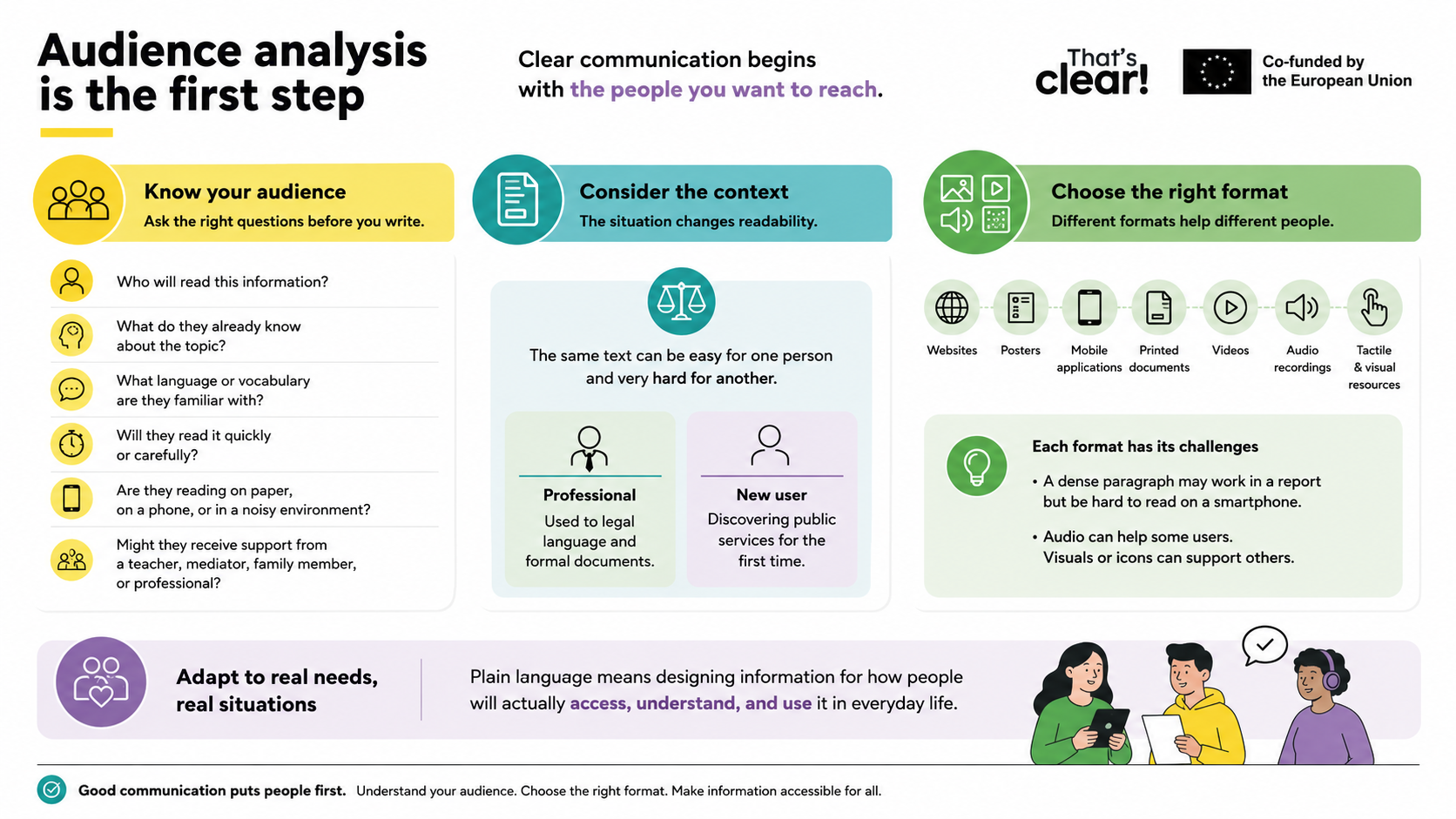
Before writing or rewriting a text, it is important to think carefully about the audience. Clear communication always begins with the needs, knowledge, and situation of the people who will receive the information.
Several questions can help guide this process:
- Who will read this information?
- What do they already know about the topic?
- What language or vocabulary are they familiar with?
- Will they read the information quickly or carefully?
- Are they reading on paper, on a phone, or in a noisy environment?
- Might they receive support from a teacher, mediator, family member, or professional?
The context in which information is accessed can completely change readability. A long administrative document may seem manageable for a professional used to legal language, but extremely difficult for someone discovering public services for the first time.
It is also important to think about the communication format. Information can be shared through:
- websites;
- posters;
- mobile applications;
- printed documents;
- videos;
- audio recordings;
- or tactile and visual resources.
Each format comes with different accessibility challenges. For example, a dense paragraph may work in a printed report but become difficult to read on a smartphone screen. Audio content may help some users, while visuals or icons may support others.
Good communication adapts to real user needs and real situations. Instead of designing information only from an institutional perspective, plain language encourages organisations to think about how people will actually access, understand, and use the information in everyday life.
›
Improving communication is not only about replacing difficult words with simpler ones. The structure of a message is just as important as the vocabulary itself.
A well-structured document helps readers quickly understand: what the message is about; where to find important information; and what action they are expected to take.
A clear message should begin with a simple introduction that immediately explains the topic. For example:
- “This document explains…”
- “This is an invitation to…”
- “You need to complete these steps…”
This helps readers understand the purpose of the document from the beginning instead of searching for the main information inside long paragraphs.
Information should then follow a logical order. A useful method is to organise content around simple questions: Who? What? Where? When? How? Why?
Clear structure also improves visual readability. Short paragraphs, headings, white space, bullet points, and numbered lists help readers navigate the document more easily.
Different types of lists can communicate different things:
- numbered lists suggest a sequence or steps to follow;
- bullet points present separate ideas without a specific order.
For example:
Numbered list
- Create an account
- Confirm your email
- Complete the registration form
This shows a process that must follow a specific order.
Bullet list
- passport
- proof of address
- bank details
This simply presents required documents without priority or sequence.
Using structure effectively can greatly reduce confusion and cognitive load. Even complex information can become easier to understand when it is organised clearly and presented step by step.
Plain language does not create one single “perfect” version of a text. Different clear versions may exist for the same document. The important goal is always the same: helping readers find, understand, and use information more easily.
›
Accessible communication is not only about language. The visual and technical presentation of information also plays an essential role in readability and understanding.
A document may use simple words but still remain difficult to read if the design creates visual barriers. Small font sizes, weak contrast between text and background, overcrowded pages, or long dense paragraphs can quickly become tiring and confusing for readers.
Universal design encourages the creation of communication that is easy to access, understand, and navigate for as many people as possible.
Several practical recommendations can improve readability:
- use a readable font size;
- create enough spacing between lines and paragraphs;
- avoid very long lines of text;
- organise information clearly;
- and use strong contrast between text and background colours.
Complex layouts, such as multiple columns or overloaded pages, can increase cognitive effort and make reading more difficult, especially on phones or small screens.
Visual elements can also support understanding. Tables, icons, illustrations, arrows, diagrams, and colour coding may help readers identify important information more quickly. However, visuals should support the message, not overload it.
Universal design also recommends presenting important information in more than one format whenever possible. For example:
- written text combined with audio explanations;
- visual instructions supported by text;
- subtitles for videos;
- or tactile resources for some audiences.
This multimodal approach helps support people with sensory impairments, reading difficulties, attention difficulties, or different learning preferences.
Digital accessibility is another important aspect of universal design. Accessible content should work correctly across different devices and remain compatible with assistive technologies such as:
- screen readers;
- text-to-speech tools;
- keyboard navigation;
- or magnification software.
The goal of universal design is not to create “special” communication for a few people. The goal is to design communication that works better for everyone from the beginning.
›
Plain language is no longer only a collection of good practices used by a few organisations. It has become an international movement supported by institutions, public administrations, researchers, and accessibility professionals around the world.
Today, several international standards and official initiatives help organisations improve the clarity and accessibility of their communication.
One important reference is the ISO 24495-1 standard, published in 2023. This international standard provides guidelines for clear communication and defines plain language as communication that allows people to:
- easily find information;
- understand what they read;
- and use the information effectively.
The standard focuses on three main areas:
- content (vocabulary and grammar);
- structure (organisation and hierarchy of information);
- and presentation (layout and readability).
›
The European Union has developed several initiatives promoting accessible communication. One example is the “Clear Writing for Europe” initiative, which encourages European institutions to produce simpler and more understandable public information.
Different practical tools can support plain language work in everyday situations. These include:
- online contrast checkers for visual accessibility;
- readability and accessibility evaluation tools;
- text-to-speech functions;
- and AI-based simplification tools.
Some AI tools developed or recommended by European institutions can automatically suggest simpler versions of texts. These tools may help identify long sentences, technical vocabulary, or overly complex structures.
However, automatic simplification also has limits. In legal, administrative, or medical contexts, AI tools may unintentionally remove important details or simplify concepts too much. A technically correct sentence may lose part of its legal meaning during automatic rewriting.
For this reason, technology should support — not replace — human expertise.
Human review remains essential. Testing texts with real users is also one of the most effective ways to improve communication. A document may seem clear to its author but still create confusion for readers discovering the information for the first time.
Plain language tools are therefore most useful when combined with:
- critical review;
- accessibility knowledge;
- and feedback from real users.
You can find more information about Plain language and editing at the European Commission here

›
⌄
›
Communication addressed to young people is often created without their direct involvement. As a result, messages may become unclear, inaccessible, or disconnected from the realities and needs of the people they are meant to reach. Young people, especially those from marginalised backgrounds, are experts in their own experiences and can provide valuable perspectives on barriers, accessibility, and engagement.
Involving young people in communication processes requires direct involvement and helps organisations create more relevant, understandable, and trustworthy messages. Participation also strengthens young people’s confidence, sense of belonging, and active citizenship. Inclusive communication therefore requires moving from communication « about » young people towards communication « with » young people.
›
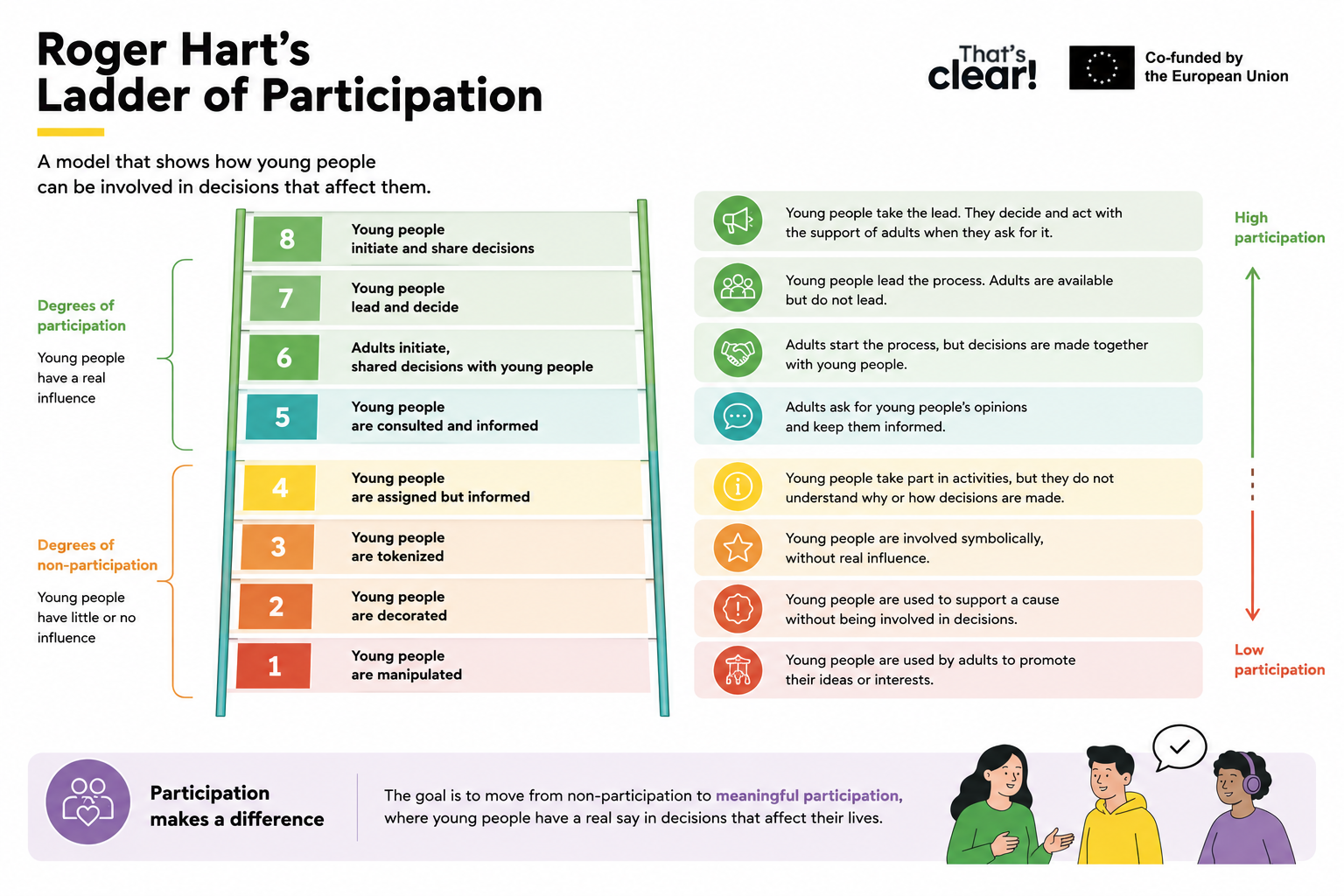
Youth participation should not be understood as a symbolic gesture or a one-time consultation. Meaningful participation is a continuous process in which young people are actively involved in discussions, decisions, and creative processes that affect them. Roger Hart’s Ladder of Participation highlights the difference between tokenistic participation and genuine co-creation.
Lower levels of participation often involve manipulation or decorative involvement, while higher levels involve shared decision-making and youth-led initiatives. The goal of inclusive communication is not simply to ask young people for feedback, but to create spaces where they can contribute ideas, influence decisions, and shape communication strategies together with adults.
›
Non-formal education offers effective methods for engaging young people in communication processes because it prioritises participation, flexibility, creativity, and experience-based learning. Unlike traditional educational approaches, non-formal education encourages dialogue, collaboration, and active involvement.
Methods such as storytelling, theatre, visual mapping, co-creation workshops, role-playing, and peer learning create opportunities for young people to express themselves in different ways. This is particularly important when working with diverse groups with different communication needs, literacy levels, or learning styles. Non-formal education therefore creates more accessible and empowering learning environments.
›
Inclusive communication means recognising that not all young people access information, express themselves, or participate in the same ways. Factors such as language barriers, disabilities, literacy levels, cultural background, gender identity, or social exclusion can influence participation.
Creating inclusive communication processes means adapting methods, using clear language, providing multiple formats, and creating safe and respectful environments. Inclusion is not only about representation but also about accessibility and power sharing. Young people should feel heard, respected, and able to contribute meaningfully. Inclusive communication therefore requires constant reflection, flexibility, and openness to different perspectives.
›
Participatory workshops are effective tools for involving young people in improving communication within organisations. A well-designed workshop creates opportunities for dialogue, creativity, and collective problem-solving. Facilitators should define clear objectives, choose methods adapted to the target group, and create a structure that balances participation and guidance.
Activities can include brainstorming, co-design sessions, theatre exercises, visual activities, or collaborative storytelling. It is also important to consider practical elements such as space, materials, accessibility, and group dynamics. A successful participatory workshop allows young people not only to share opinions but also to actively contribute to concrete outcomes.
›
Creative methods can make communication processes more accessible and engaging for young people. Visual arts, theatre, movement, storytelling, and collaborative games allow participants to express ideas beyond written or verbal language. These methods are particularly useful when working with groups that may experience barriers related to literacy, language, or confidence.
Creativity can also reduce hierarchy between facilitators and participants by encouraging experimentation and shared exploration. Inclusive communication is not only about simplifying language, but also about creating multiple ways for people to understand, participate, and express themselves.
›
Reflection is an essential part of non-formal education and inclusive communication processes. Activities become more meaningful when participants have time to analyse what happened, how they felt, and what they learned. Reflection allows participants to connect experiences with broader concepts such as participation, inclusion, collaboration, and communication barriers.
Facilitators can support reflection through open questions, group discussions, visual methods, or individual writing exercises. Reflection also helps participants identify practical applications for their own organisations and communities. Learning therefore becomes more sustainable and transferable.
›
Inclusive communication cannot depend only on individual motivation. Organisations also need to create structures, habits, and strategies that support participation and accessibility over time. This may include involving young people in planning processes, reviewing communication materials, creating feedback systems, or developing internal guidelines for inclusive communication.
Organisational change often happens gradually through small, consistent actions rather than radical transformations. Building inclusive practices requires collaboration, commitment, and openness to continuous learning. Youth workers can play an important role in initiating and supporting these changes within their organisations.
›
Implementing participatory and inclusive communication practices can involve several challenges. Youth workers may face limited resources, time constraints, institutional resistance, or uncertainty about how to adapt methods to diverse groups. Some organisations may also struggle to move beyond traditional top-down communication approaches.
Recognising these barriers is an important step towards addressing them. Collaboration, experimentation, peer support, and gradual implementation can help organisations develop more inclusive communication cultures. Challenges should not be seen as failures, but as opportunities for learning and improvement.
›
The final goal of inclusive communication is not simply to make information easier to understand, but to create communication processes where young people actively contribute as partners and co-creators. When young people participate meaningfully, communication becomes more relevant, authentic, and accessible.
Co-creation strengthens ownership, trust, and community engagement while helping organisations better respond to the realities of diverse youth groups. Inclusive communication therefore represents both a practical strategy and a democratic value. It is a process that requires listening, collaboration, adaptability, and a willingness to share responsibility.
›
⌄
›
[Contenu à ajouter]